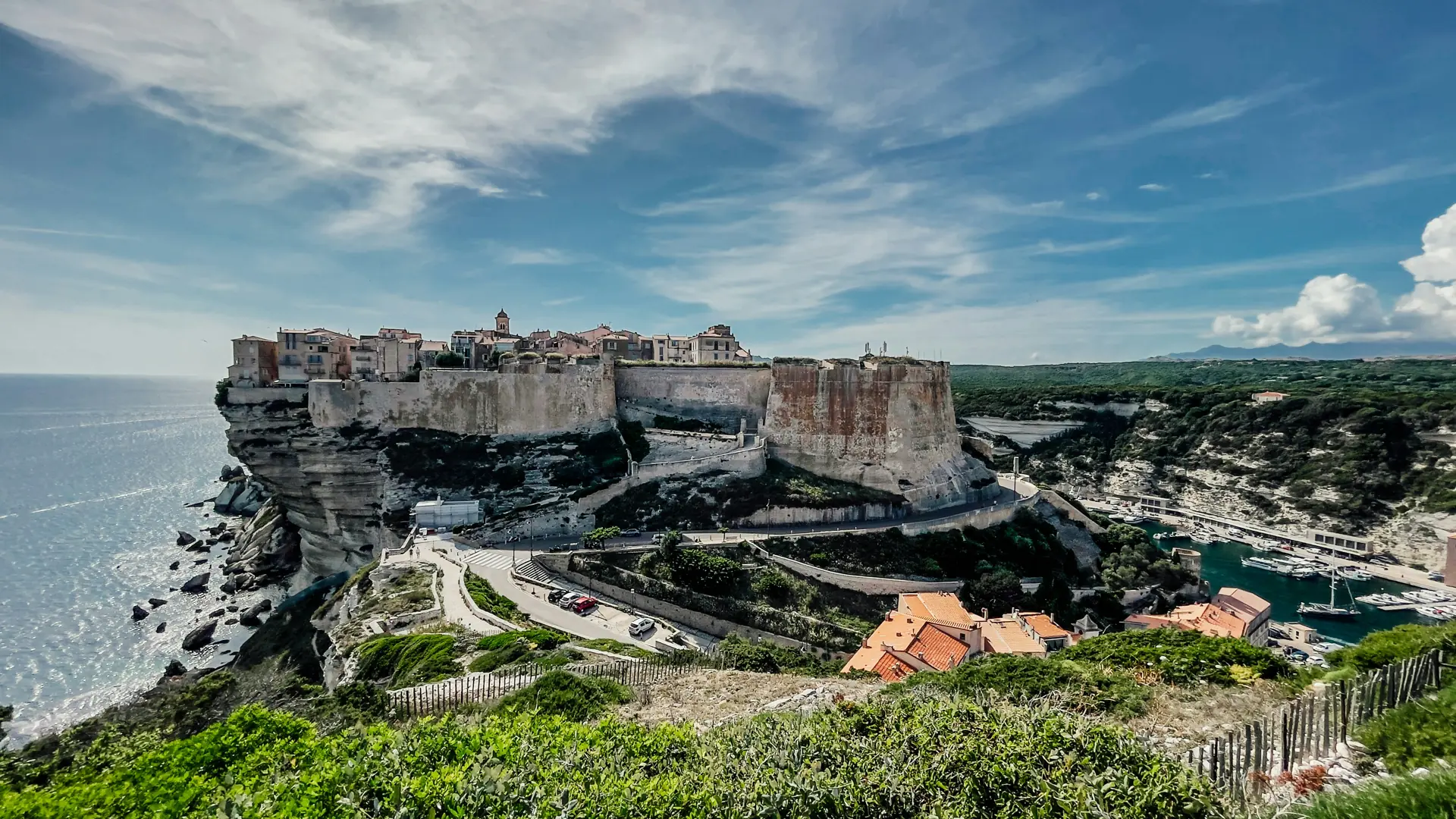
There are cities that seem to defy the laws of gravity, places where stone and sky merge in a sublime vertigo. Bonifacio is one such place. Perched atop white limestone cliffs that plunge sheer into an ink-blue sea, this medieval citadel is one of the most breathtaking sights anywhere in the Mediterranean. From Villa Azaitu, forty-five minutes of driving is all it takes to reach this marvel. Forty-five minutes through fragrant maquis, pink granite hills and sea views, before discovering a town that has no equal in Corsica, nor perhaps anywhere else.
Visiting Bonifacio is a journey through time. It means walking in the footsteps of the Genoese, the Aragonese, the corsairs and the fishermen who shaped this town over centuries. It also means witnessing a natural spectacle of rare power, cliffs sculpted by wind and waves over millennia. Here is our guide to an unforgettable day trip from Porto-Vecchio to this extraordinary citadel.
A citadel between sky and sea
Arriving in Bonifacio is an experience in itself. The town reveals itself gradually, beginning with its natural harbour, a narrow, deep fjord that cuts into the land like a gash in the rock. Sailing boats and yachts are moored in tight rows, and restaurant terraces line the quays in an atmosphere that oscillates between fishing port and luxury marina. This is where the adventure begins.
Look up. Above you, the upper town rises on its limestone spur, as if balanced on the edge of the void. The boldest houses overhang the cliffs, their foundations clinging to the white rock, their balconies suspended above sixty metres of empty air. This vision, both majestic and vertiginous, resembles nothing else in Corsica. Bonifacio is a world apart, a town born from the meeting of human obstinacy and the power of nature.
The ascent to the upper town can be made via the Rampe Saint-Roch, a paved path that winds between the ramparts, or by the monumental staircase that climbs from the harbour. Each step reveals a broader panorama, a more spectacular angle. And when you finally pass through the Porte de Gênes, you enter another century.
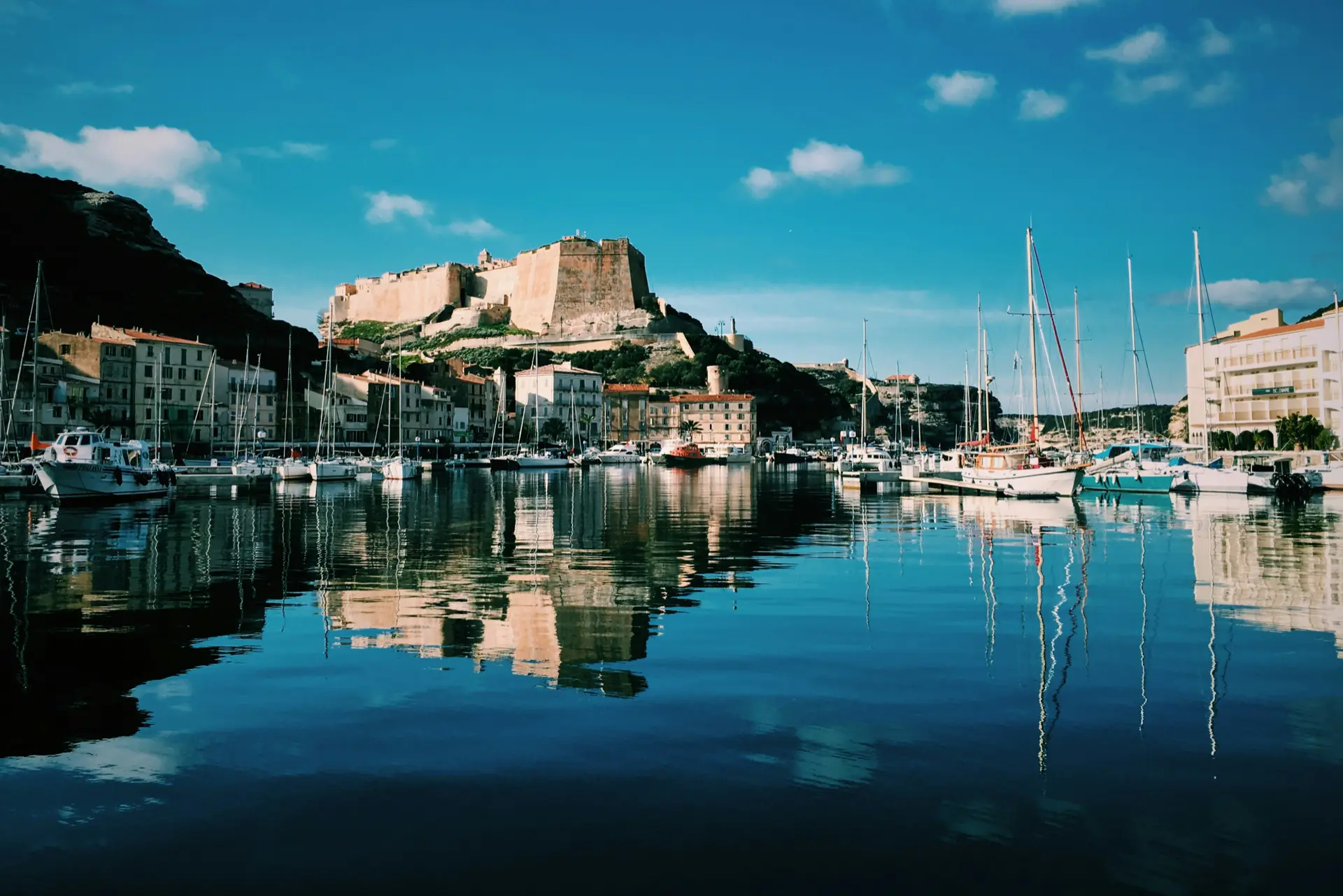
The citadel and the old town
The upper town of Bonifacio is a labyrinth of narrow streets, vaulted passages and staircases that climb and descend between tall, tightly packed houses. Genoese architecture has left its mark everywhere: colourful facades, flying buttresses spanning the streets, laundry drying between windows. One loses oneself here with pleasure, discovering around a corner a Romanesque church, a secret garden or a glimpse of the sea of staggering beauty.
The Church of Sainte-Marie-Majeure, at the heart of the citadel, deserves a pause. Its loggia once served as a meeting place for the town elders, and its cistern collected rainwater that supplied the entire community. Further along, the Church of Saint-Dominique, one of the rare Gothic buildings in Corsica, surprises with its elegant severity. But the true treasure of the upper town is the walk along the ramparts. From there, the gaze embraces the blue immensity, the white cliffs outlined below, and on a clear day, the wild silhouette of Sardinia just twelve kilometres away.
The citadel itself, with its massive bastions and its barracks converted into a cultural space, tells nine centuries of military history. Here, people withstood terrible sieges, repelled armies, survived famine. The walls still bear the scars of those battles, and it is difficult not to feel, when touching them, the weight of that memory.
The King of Aragon's staircase
This is undoubtedly Bonifacio's most famous site, and certainly its most spectacular. Carved directly into the limestone cliff, the King of Aragon's staircase descends 187 steps towards the sea in a dizzying diagonal. Legend has it that it was hewn in a single night by Aragonese soldiers during the siege of 1420, to reach a freshwater spring. Historical reality is probably more prosaic, but the legend adds to the magic of the place.
The descent is striking. The steps, uneven and worn by centuries, plunge into the white cliff face. To the right, rough warm limestone beneath the hand. To the left, the void, the glittering sea sixty metres below, and the wind blowing with force. One needs a sure foot and no fear of heights, but the reward is extraordinary. Halfway down, a platform offers an unrivalled view of the cliffs, the sea and the marine caves below. One understands then why this place exercises so powerful a fascination.
The climb back up is more demanding than the descent, but each step regained opens a new angle on this mineral landscape. Allow approximately thirty minutes for the return trip, and remember to bring water. The staircase is open from April to October, with a modest entrance fee that contributes to the upkeep of this exceptional monument.
The sea caves by boat
Seen from above, Bonifacio is majestic. Seen from the sea, it is utterly breathtaking. The boat trips departing from the harbour are one of the highlights of a day trip from Porto-Vecchio, and we strongly recommend including them in your itinerary. Several companies offer circuits of about one hour, hugging the cliffs and entering the sea caves carved by erosion.
The Sdragonato cave is the most celebrated. Its pierced ceiling forms, when seen from inside, a shape that evokes the outline of Corsica. The light filtering through this natural opening creates turquoise reflections on the dark water of the cave, a spectacle of breathtaking beauty. Further on, the Saint-Antoine cave and the Napoleon cave offer other marvels, with their translucent waters and walls sculpted by millennia of marine erosion.
From the boat, one also discovers the gouvernail de la Corse, that rocky promontory jutting into the sea upon which rest the boldest houses of the upper town. Seen from below, they appear suspended in the void, defying all architectural logic. It is a perspective obtainable only from the sea, and one that alone justifies the excursion.
The Strait of Bonifacio
Between Corsica and Sardinia, the Strait of Bonifacio unfurls its intensely blue waters over barely twelve kilometres. It is one of the most beautiful and most travelled stretches of water in the Mediterranean, a legendary maritime passage that the navigators of antiquity approached with respect and caution. The currents are powerful, the wind sometimes funnels through with violence, but in fair weather the spectacle is one of absolute serenity.
The Lavezzi Islands, a granite archipelago scattered across the strait, constitute a nature reserve of primitive beauty. Their wind-polished rocks, their coves of crystalline water and their low vegetation create an almost unreal landscape, between Corsica and Sardinia, between Europe and Africa. Some boat excursions from Bonifacio include a stop at the Lavezzi, and we can only recommend this extension for those who have a full day to spare.
The Strait of Bonifacio is also a marine sanctuary. Dolphins, loggerhead turtles, groupers and corals find refuge in waters protected by an international marine park. This underwater richness, invisible from the cliffs but present in every reflection, gives this landscape an additional depth. Beneath the turquoise surface, an entire world pulses with life.
Practical information: access, parking and hours
From Villa Azaitu, Bonifacio is reached in forty-five minutes via the N198 then the T40, a pleasant road that traverses landscapes of maquis and granite hills. The journey is part of the pleasure, particularly when the road begins to follow the coast and the first glimpses of the white cliffs appear on the horizon.
Parking in Bonifacio requires a little planning in high season. The main car park is near the harbour, with a reasonable hourly rate. In July and August, we recommend arriving before ten o'clock to find a spot easily. An upper car park near the citadel offers an alternative for those who wish to begin their visit from the upper town. Free shuttles sometimes link the outlying car parks to the centre.
For the King of Aragon's staircase, expect a paid entrance of around 3.50 euros, generally open from April to October, from 9 am to 7 pm in high season. Boat trips depart from the harbour approximately every thirty minutes, with fares of around 25 euros per adult for the cave circuit. We suggest booking the evening before through our concierge service, which knows the best companies and can secure preferred departure times.
For lunch, the harbour offers many terraces, but we have a soft spot for the small restaurants of the upper town, more intimate and often less crowded. A dish of grilled lobster on a terrace overlooking the cliffs remains one of the most memorable lunches that Corsica can offer. Remember to book in high season.
Discover Bonifacio from Villa Azaitu, just 45 minutes from the city of cliffs.
Book your stay