
Napoleon said he could recognise Corsica with his eyes closed, simply by its scent. That scent is the maquis. The dense, fragrant vegetation that blankets the hills, valleys and paths of the island like a living mantle. From the terrace of Villa Azaitu, the maquis is everywhere. It descends from the hills, envelops the path leading to Palombaggia, brushes against the dry stone walls and perfumes the morning air with a fragrance one never forgets.
The Corsican maquis is not mere scenery. It is an ecosystem of extraordinary richness, a botanical world that conceals medicinal plants, age-old aromatics and secrets that shepherds and healers have passed down for generations. To walk through it is to enter the intimacy of Corsica, to touch its botanical soul, to understand the deep bond that unites the island with its land.
The maquis, soul of Corsica
The word maquis comes from the Corsican macchia, meaning stain or spot. A dense, impenetrable spot of greenery that covers nearly half the island's surface. This Mediterranean plant formation, one to three metres high, is composed of shrubs, bushes and aromatic plants that have adapted to summer drought and poor soils with admirable resilience.
In South Corsica, the maquis takes on a particular dimension. The proximity of the sea, the generous sunshine and the granite soils create conditions that favour exceptional botanical diversity. Around Palombaggia, more than two hundred different plant species can be counted within a small area. Each has its season, its flowering, its scent. The maquis changes its face throughout the year, moving from the deep green of winter to the yellows and whites of spring, then to the ochres and golden browns of summer.
What strikes you first is the smell. A complex fragrance, at once sweet and peppery, resinous and floral, that varies with the time of day and the temperature. In the morning, when the dew evaporates under the first rays of sun, the maquis exhales its most subtle aromas. In the late afternoon, when the accumulated heat releases the essential oils from the leaves, the scent grows more powerful, almost intoxicating. It is this olfactory signature that earned Corsica its nickname of the island of scents.
The emblematic plants
Immortelle, Helichrysum italicum, is the undisputed queen of the Corsican maquis. Its small golden-yellow flowers, which never wilt, release a unique scent, at once honeyed and slightly spiced, recognisable anywhere. Corsican immortelle essential oil is considered one of the most precious in the world for its regenerative properties. It is harvested in June and July, when the hills turn gold and the air vibrates with its heady perfume.
Cistus, with its white or pink flowers as fragile as tissue paper, is the other emblematic figure of the maquis. Its resin, labdanum, was used in antiquity as incense and medicine. To this day, it is used in the composition of luxury perfumes. Myrtle, with its midnight-blue berries and evergreen foliage, has accompanied Corsicans since time immemorial. Its liqueur, with a flavour both sweet and bitter, is the island's traditional digestif, served chilled at the end of a meal.
The strawberry tree, which Corsicans call arbutus, produces small red fruits in autumn that resemble tiny strawberries. They are used to prepare delicate jams and a fragrant eau-de-vie. Lentisk, wild rosemary, French lavender, thorny broom, tree heather: each species adds its note to the olfactory concert of the maquis. Together, they compose a sensory landscape of unequalled richness in the Mediterranean.
Hiking trails through the maquis
From Villa Azaitu, the path that descends towards Palombaggia is the first immersion into the maquis. Four hundred metres through dense vegetation that envelops you in its fragrances, beneath a canopy of maritime pines that filters the light into patterns of shadow and sun. It is a walk of just five minutes, yet sufficient to grasp the power of this ecosystem.
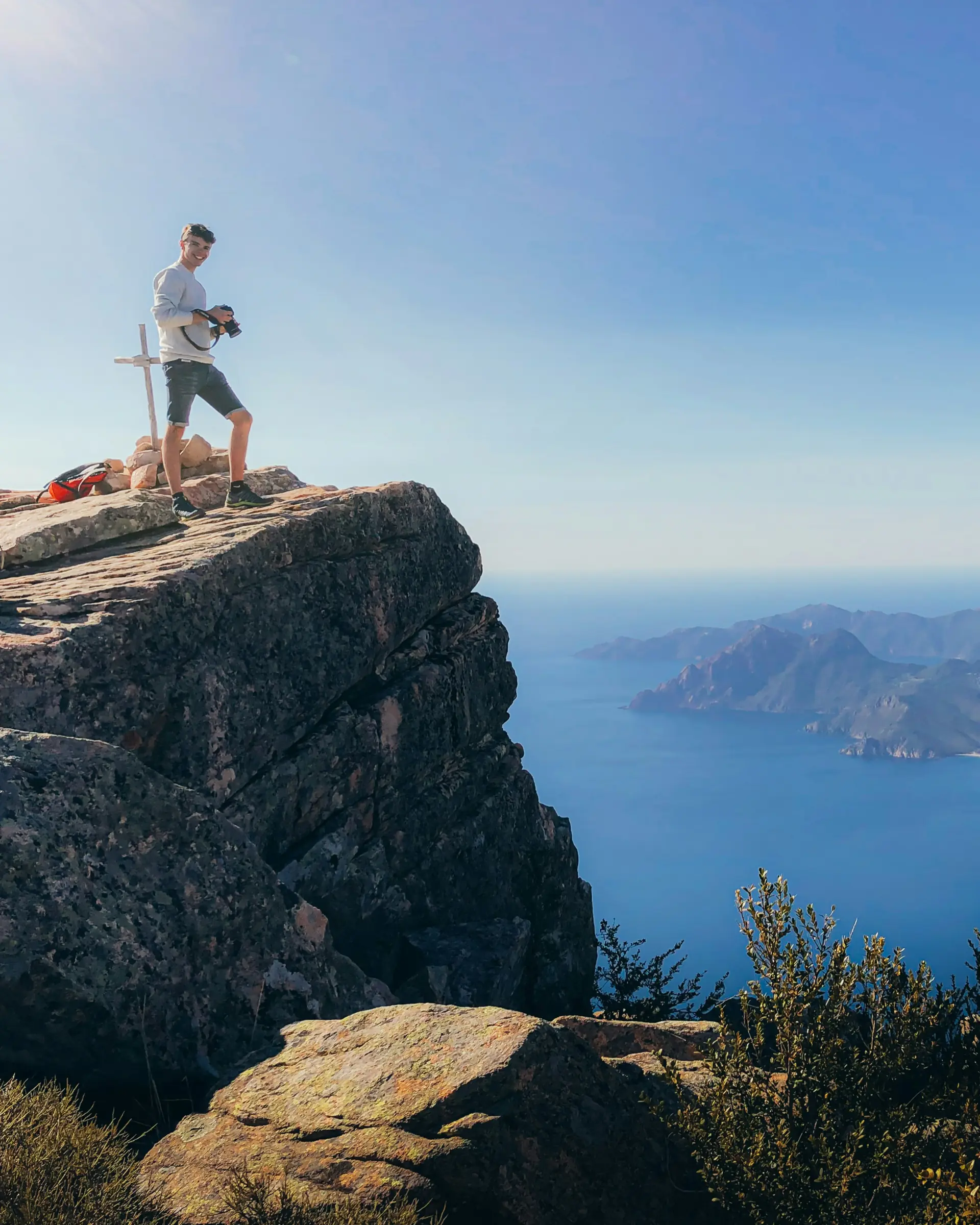
For more ambitious hikers, the coastal path from Palombaggia heading south offers a more complete experience. Two to three hours of walking along the coast, between wild coves and maquis-covered hills, with unimpeded views of the Cerbicales Islands. The trail alternates between seaside passages and climbs into the maquis, allowing you to appreciate the diversity of environments. In spring, the cistus is in bloom and the immortelle is beginning to gild the hills.
The hinterland of Porto-Vecchio also conceals remarkable trails. The forest of Ospedale, thirty minutes from the villa, offers altitude hikes where the maquis gradually gives way to Laricio pines and ancient chestnut trees. The Piscia di Gallu waterfall, accessible by a forty-five-minute trail, is a spectacular reward. We recommend setting out early in the morning, when the trails are cool and the fragrances most intense.
The maquis and gastronomy
The Corsican maquis is not only a landscape. It is a larder. For centuries, Corsicans have drawn from this wild vegetation ingredients that nourish their cuisine and their traditions. Maquis honey, classified AOP, is one of the most complex and sought-after in France. Its aromas of chestnut, strawberry tree and immortelle make it an exceptional product, quite different from the floral honeys of the mainland.
The essential oils of the Corsican maquis sustain a flourishing artisanal industry. Immortelle, myrtle, lentisk and cistus are carefully distilled by local producers who perpetuate ancestral knowledge. These oils find their way into luxury cosmetics, wellness treatments and home fragrances that our concierge service can help you discover through visits to producers.
Myrtle liqueur, strawberry tree jam, fig vinegar, chestnut eau-de-vie. Each maquis product tells the story of a unique terroir. At the Porto-Vecchio markets, the stalls overflow with these treasures. A sheep's cheese aged in cellars where the maquis scents the ambient air, charcuterie from pigs fed on acorns and chestnuts beneath the maquis canopy. The island is to be tasted as much as it is to be contemplated.
A scent one never forgets
The Corsican maquis is a total sensory experience. It is seen, heard, touched, tasted, but it is through smell that it most deeply marks the memory. Years after a stay in Corsica, the merest scent of a rosemary branch or an immortelle flower brings everything back. The light, the warmth, the sound of cicadas, the blue of the sea glimpsed between the branches.
From the terrace of Villa Azaitu, the maquis is the first fragrance of the morning and the last of the evening. It accompanies breakfast, envelops the afternoon rest, perfumes the sunset aperitif. It is there, discreet and constant, like the breath of the island itself. Guests staying here for the first time are often surprised by the intensity of this botanical presence. Those who return say it was this scent that called them back.
The maquis is the soul of Corsica. To know it is to understand the island in its most intimate, most true, most irreducible essence. It is also to access a form of beauty that cannot be photographed, that cannot be filmed, but that inscribes itself in you with a force that few landscapes possess. The maquis is to be lived. And once lived, it is never forgotten.
Experience the maquis every day from Villa Azaitu, nestled in the heart of Corsican vegetation.
Book your stay