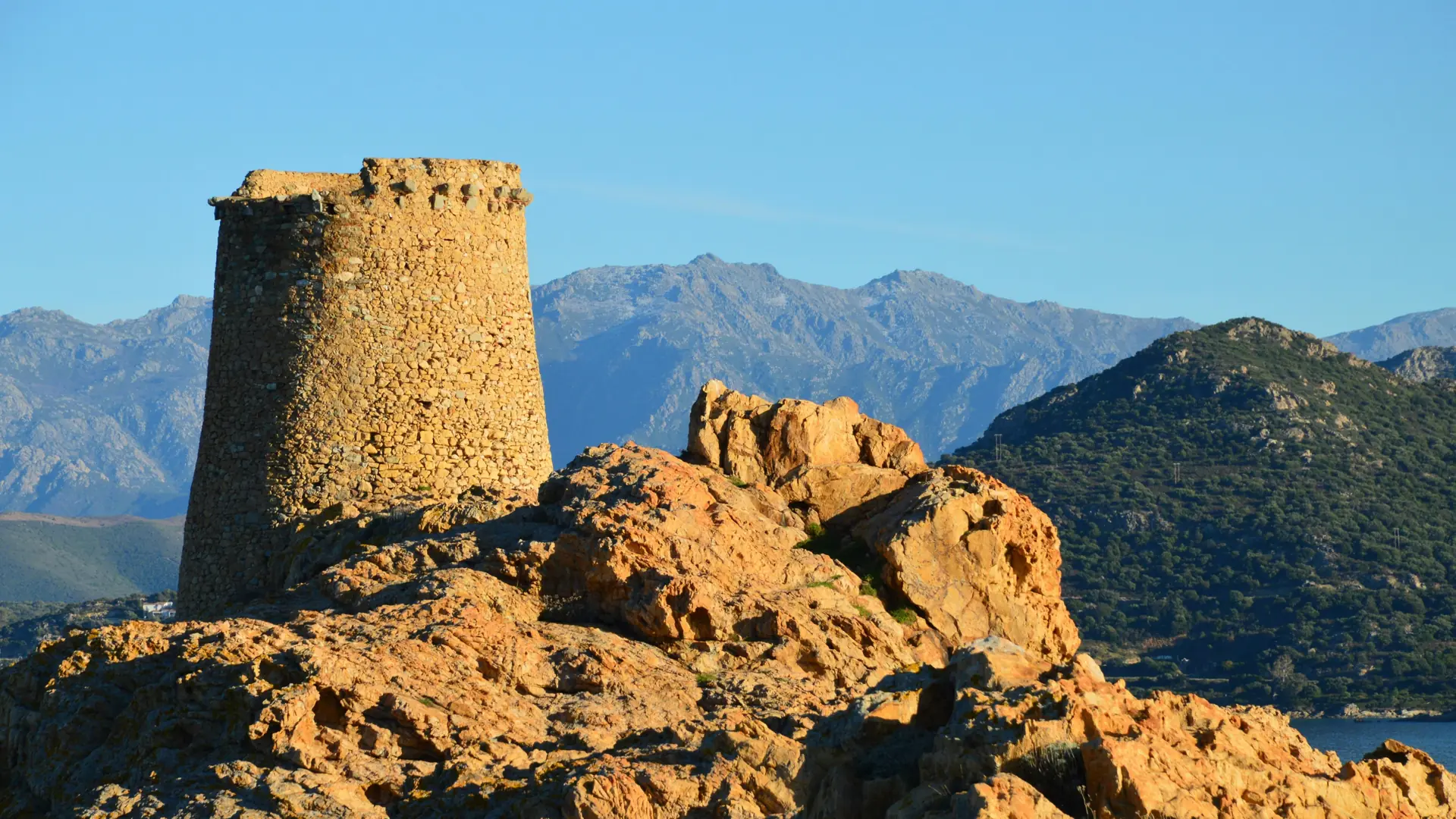
They stand there, perched on rocky headlands like timeless watchmen. Round, trapezoidal, sometimes half-collapsed, the Genoese towers of Corsica punctuate the coastline with a regularity that is anything but accidental. Each one was placed there for a precise reason: to watch the sea, to spot the enemy, to raise the alarm. Today, these granite sentinels have found a new vocation. They mark out some of the most beautiful hiking trails in the Mediterranean, offering walkers striking viewpoints over a pristine coastline.
Around Porto-Vecchio, several Genoese towers can be easily visited, on foot or by combining car and walking. They make ideal excursions for mornings or late afternoons, when the light is soft and the heat has not yet taken hold. From Villa Azaitu, each of these towers is within forty minutes by road. Here is our selection, between history, nature and light.
Sentinels of the sea: the history of the towers
It was in the sixteenth century that the Republic of Genoa, which had administered Corsica since 1284, decided to erect a network of coastal towers to protect the island from Barbary incursions. Raids by North African pirates were then a constant threat. They came to plunder coastal villages, kidnap inhabitants for slavery, and departed as swiftly as they had arrived. The terror they inspired had emptied the coastline of its people.
In 1530, Genoa launched a vast building programme. Within a few decades, more than ninety towers were erected along the Corsican coast, spaced so that each tower could see its two neighbours. The system worked by smoke signals during the day and fires at night. As soon as a lookout spotted a suspicious sail on the horizon, he lit a signal, relayed from tower to tower within minutes. The alert could thus travel the entire coast in less than an hour, giving inhabitants time to take refuge in the fortified villages of the interior.
Each tower housed a small garrison of two to four men, the torregiani, who lived there in rotations lasting several months. Their existence was harsh: isolated, exposed to wind and spray, they had to remain vigilant day and night. But their role was vital. Thanks to this surveillance network, the Corsican coasts gradually recovered a relative security, and the population was able to return to the shoreline. Today, around sixty-seven towers remain standing in Corsica, some twenty of them in South Corsica, silent but eloquent witnesses to this turbulent era.
The tower of Fautea
The tower of Fautea is arguably the most accessible and most photogenic of the Genoese towers around Porto-Vecchio. Situated around twenty minutes by road north of the town, it stands on a small rocky headland that separates two coves of golden sand. You reach it directly from the car park, in just a few steps, making it an ideal excursion for families.
The tower, carefully restored, retains its characteristic cylindrical silhouette. Its thick walls of pink granite, pierced by narrow arrow slits, stand out against the deep blue of the sea. The beach that surrounds it is magnificent, a sheltered cove with calm and transparent waters where you can swim after the visit. The contrast between the ruggedness of the fortress and the gentleness of the setting is striking.
In the late afternoon, when the raking light gilds the granite and stretches the tower's shadow across the sand, the place takes on an almost unreal beauty. Photographers are not mistaken: Fautea is one of the most photographed spots in South Corsica. But even in high season, arriving early in the morning or at the end of the day is enough to recover the serenity that the sixteenth-century torregiani knew, in rather less austere circumstances.
The tower of La Chiappa
Closer to Porto-Vecchio, the tower of La Chiappa occupies the tip of the peninsula of the same name, at the entrance to the gulf. To reach it, you follow a path that winds through the maquis for around thirty minutes, an easy walk but long enough to discourage the less motivated and preserve the tranquillity of the place.
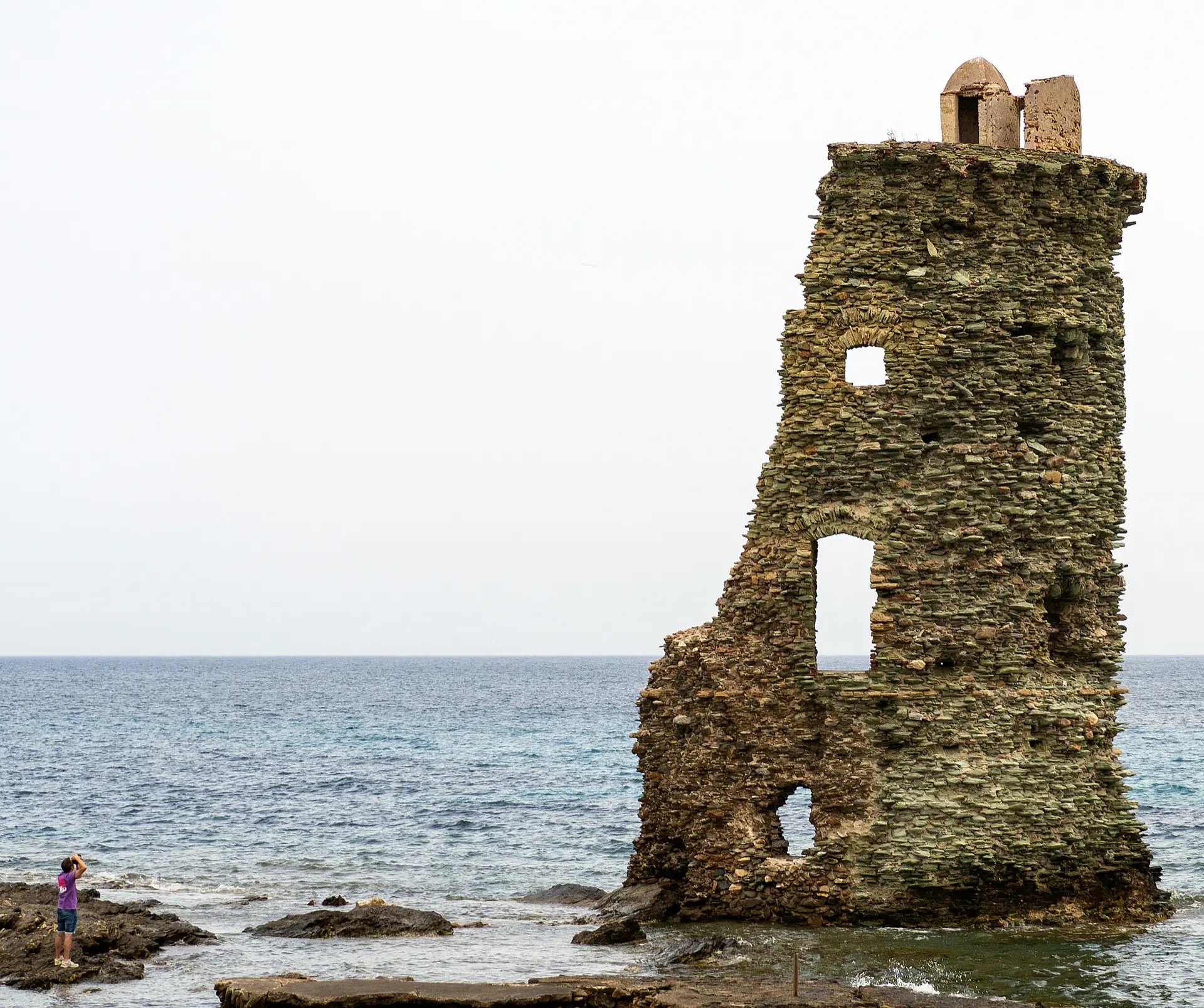
The tower itself is in ruins, but it is precisely this ruination that gives it its charm. The crumbled walls let through the light and the wind, and the vegetation has reclaimed its rights, mingling grey granite with the deep greens of lentisk and arbutus. The panorama from the headland is spectacular: on one side, the Gulf of Porto-Vecchio and its calm waters; on the other, the open sea and, on a clear day, the Cerbicales Islands resting on the horizon.
The walk to the tower of La Chiappa is particularly pleasant in spring, when the maquis is in flower and the air is fragrant with immortelle and rockrose. In summer, choose the morning hours. Bring water and a hat, as the path is exposed. The reward, at the end of the trail, matches the effort: a feeling of being at the edge of the world, facing the immensity of the Mediterranean.
The customs path: from tower to tower
For more ambitious walkers, the customs path offers the possibility of linking several Genoese towers in a single hike. This coastal trail, inherited from nineteenth-century customs patrols, follows the shoreline, tracing every cove, every headland, every inlet. The stretch between Palombaggia and the Chiappa headland is particularly recommended for a Genoese towers hiking route in Corsica.
The route alternates between passages through woodland, crossings of deserted beaches and ascents to rocky promontories from which the view stretches to infinity. You pass from one tower to the next as the lookouts once passed their messages, following the line of the coast. The walk takes around three hours for seven kilometres, with moderate elevation gain. The terrain is sometimes rocky, sometimes sandy, always superb.
The path also crosses areas of dense maquis where scents succeed one another: rosemary, myrtle, lentisk, wild lavender. In spring, rockroses cover the hillsides with white and pink flowers. In summer, cicadas accompany every step with their strident song. It is a hike that engages all the senses, and that reminds you at every turn that South Corsica is a land where history and nature have become inseparably intertwined.
The towers at sunset
If there is an ideal moment to visit a Genoese tower, it is at sunset. These massive structures, already impressive in broad daylight, take on an almost mystical dimension when the evening light envelops them. The pink granite catches fire, shadows stretch across the sea, and for a moment you imagine the lookout of old, standing on the summit platform, scanning the horizon in the fading light.
The tower of Fautea at dusk is a spectacle in itself. The sun descends behind the mountains, and the tower stands in silhouette against a sky of fire. The tower of La Chiappa offers a different register: turned towards the open sea, it catches the last rays bouncing off the water's surface, creating a play of reflections and contre-jour that defies photography.
For guests at Villa Azaitu, these late-afternoon excursions are the perfect complement to days at the beach. After a day of lounging at Palombaggia or Santa Giulia, taking an hour's walk to a Genoese tower to watch the sunset is to enrich your stay with a cultural and contemplative dimension. It is to understand that the beauty of South Corsica lies not only in its beaches, but also in these stones heavy with history that have watched over the shore for five centuries.
Fancy discovering the Genoese towers of Corsica from Villa Azaitu?
Book your stay