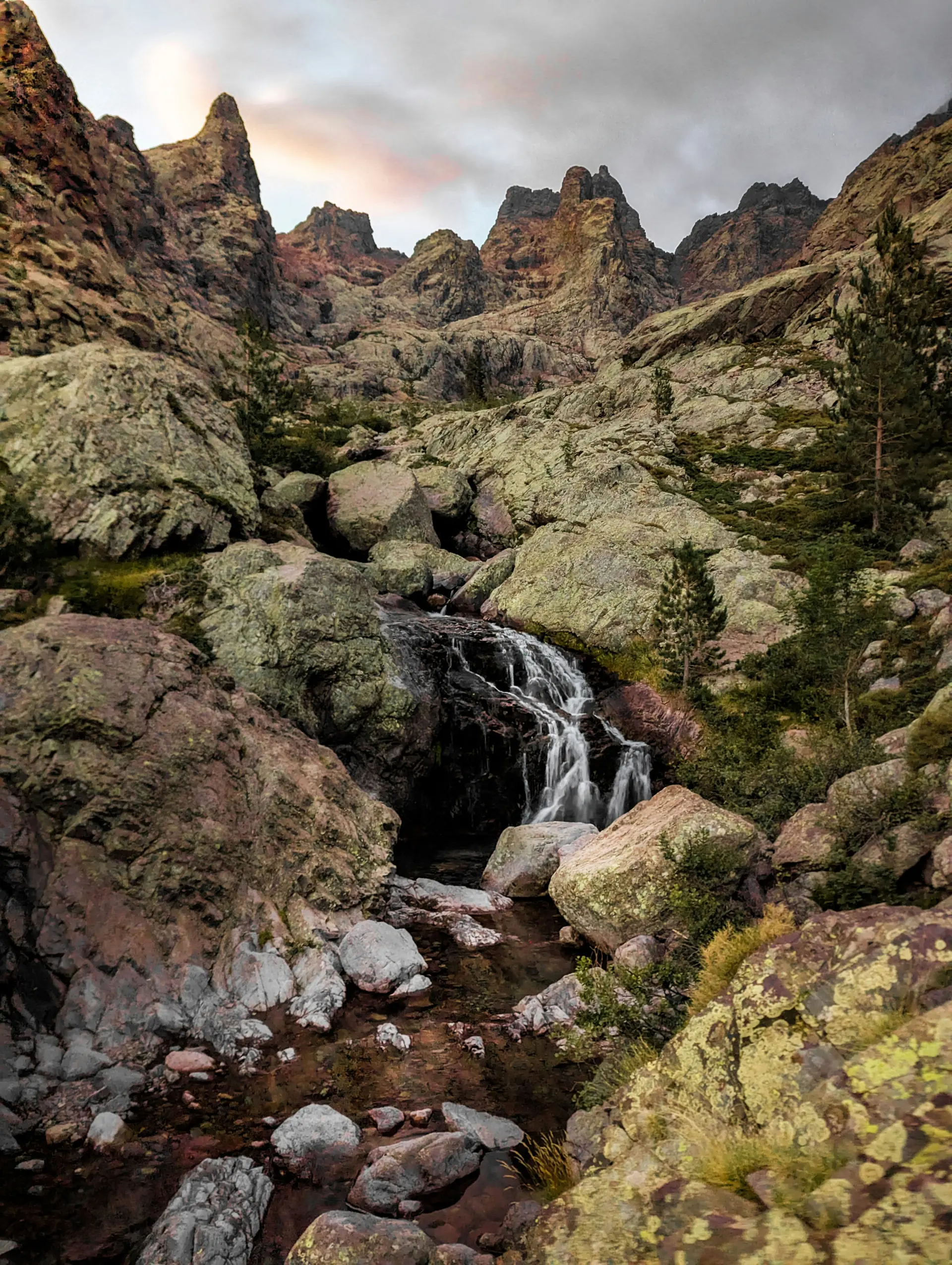
There exists, thirty minutes' drive from Porto-Vecchio, a world that most holidaymakers never discover. A world where Corsica sheds its Mediterranean face and dons the garb of a mountain forest, dense, mysterious, crossed by streams that tumble down granitic slopes in cascading torrents. This world is the Ospedale forest, and its centrepiece is the Piscia di Ghjaddu waterfall.
From Villa Azaitu, the road climbs swiftly above the coastal plain. Maritime pines give way to century-old laricio pines, the air freshens, the landscape shifts in scale. Within a few kilometres, one passes from the turquoise blue of Palombaggia to the deep green of a forest suspended between sky and rock. It is one of the most striking transitions that South Corsica can offer.
Ospedale, a suspended forest
The Ospedale forest stretches between 800 and 1,300 metres altitude, clinging to the flanks of the mountain massif that dominates Porto-Vecchio. It is a forest of laricio pines, those endemic Corsican giants whose straight, slender trunks rise to over forty metres. Their canopy filters the light and creates a particular atmosphere, between shade and brightness, that invites contemplation.
The village of Ospedale, a tiny stone hamlet perched on a ledge, offers a welcome first stop. The handful of granite houses, the fresh-water fountains and the coolness of the air contrast sharply with the heat of the coast. In summer, when the shore suffocates under the heat, the Ospedale forest offers a blessed refuge where temperatures remain pleasant.
The road through the forest is itself a spectacle. It winds between enormous granite boulders, covered in moss and lichen, that seem to have been placed there by the hand of a giant. Some of these rocks, in precarious balance, defy the laws of gravity and offer fantastical silhouettes that morning light renders particularly photogenic.
The hike to Piscia di Ghjaddu
The trail to the Piscia di Ghjaddu waterfall starts from the car park along the D368, a few kilometres past the Ospedale dam. A wooden sign marks the trailhead. The hike, rated easy to moderate, takes roughly one hour return for a modest elevation change of around 150 metres.
The path first plunges beneath the laricio pine canopy, following a stream whose murmur accompanies every step. The ground is carpeted with pine needles and light plays through the branches, creating shifting patterns on the trail. The air smells of resin, damp moss and that indefinable scent of the Corsican forest, a blend of maquis and mountain.
After some twenty minutes of pleasant walking, the path opens onto a natural viewpoint where the sight takes the breath away. The waterfall appears in all its power: a ribbon of water hurling itself into the void over nearly 70 metres, crashing into a natural pool surrounded by rock walls draped in vegetation. The spectacle is all the more impressive in spring, when snowmelt swells the flow and the cascade roars with almost violent force.
A second, steeper path allows one to descend to the foot of the waterfall. The descent demands a little more attention, with some rocky passages where metal handrails aid progress. But the reward matches the effort: at the base of the falls, the water spray creates a cool, humid micro-climate where light draws fleeting rainbows.
Ospedale Lake
Ospedale Lake, an artificial reservoir created by a dam in the 1970s, has become over the decades a natural site in its own right. Its deep blue waters, ringed by laricio pines and granite boulders, compose a postcard landscape more readily associated with Alpine lakes than a Mediterranean island.
A walking trail circles the lake in roughly ninety minutes, offering varied viewpoints over the water and surrounding mountains. In the morning, when the surface is still and the pines reflect in the water as in a mirror, the place attains an almost unreal beauty. It is the ideal moment for photographers.
Several picnic areas border the lake, allowing you to extend the outing with an open-air lunch. The pine shade, the altitude freshness and the absolute calm of the place make it a perfect pause between the waterfall hike and the exploration of the natural pools.
Swimming in the natural pools
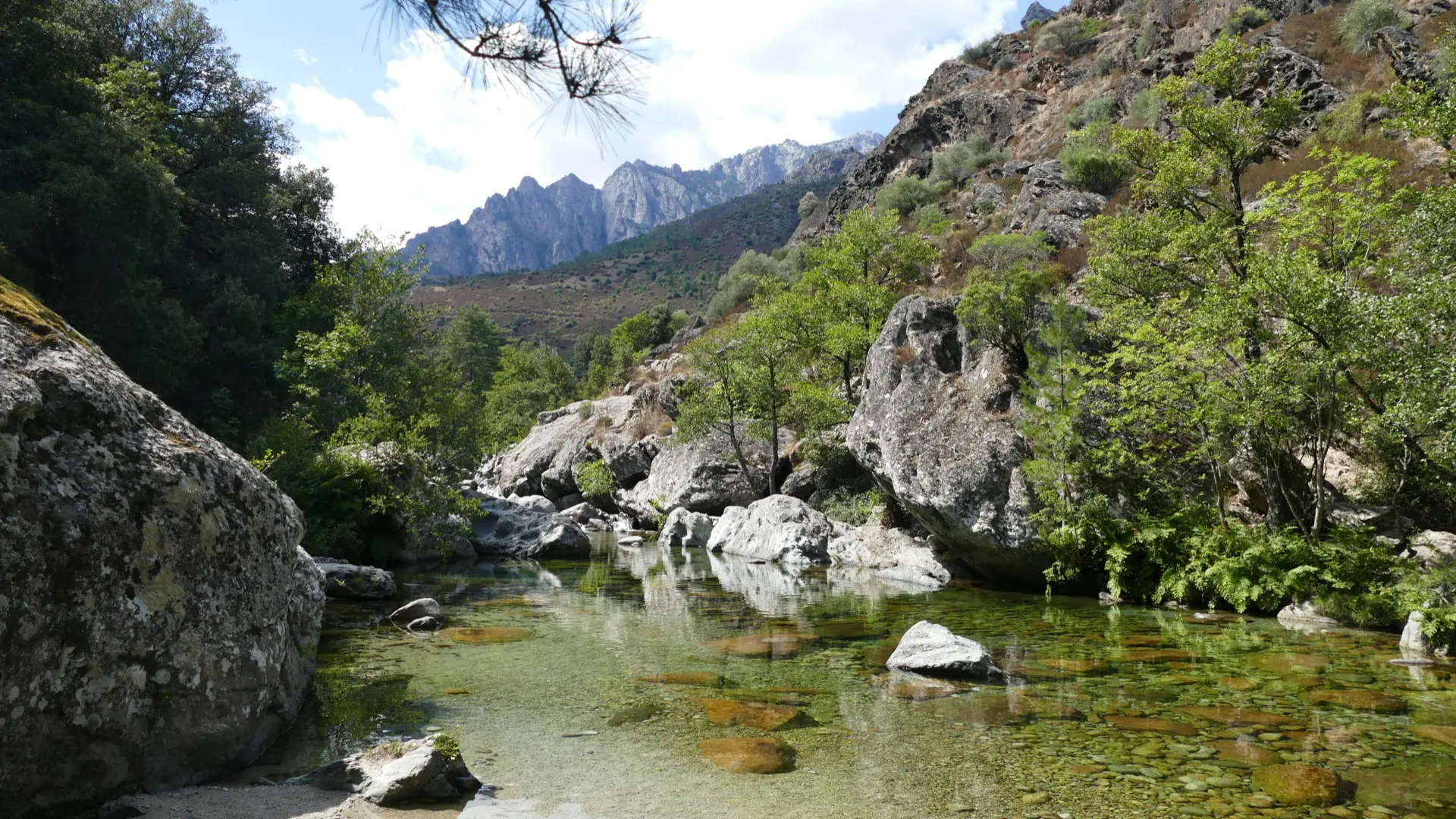
Descending from Ospedale towards Porto-Vecchio through the Cavu or Fiumicicoli valleys, the rivers have carved natural pools of wild beauty into the granite. These natural swimming holes, fed by spring water descending from the mountains, offer invigoratingly fresh bathing in an unspoilt setting.
The most accessible are found along the Cavu river, roughly twenty minutes' drive from the villa. Large boulders polished by centuries form successive basins linked by small cascades. The water, of crystalline clarity, takes on shades of jade and emerald according to depth and light. The bravest leap from the rocks into the deep pools, while others prefer to let the gentle current carry them from one basin to the next.
These natural pools are particularly appreciated in summer, when coastal heat invites a search for the freshness of the hinterland. The contrast between a morning swim at Palombaggia and an afternoon dip in a mountain pool captures perfectly the richness of South Corsica.
Practical: parking, equipment, best season
The car park for the waterfall hike is located along the D368, well signposted. In high season, arriving before ten o'clock is advised to find a space without difficulty. Parking is free.
For the hike, closed walking shoes are recommended, though the trail is manageable in trainers. Bring water, a hat and sun cream for the exposed sections. In cooler months, a light jacket is welcome as the forest can be noticeably cooler than the coast.
The best season to see the waterfall in full flow is spring, from March to June, when winter rains and snowmelt generously feed the watercourse. In summer, the flow diminishes considerably and the cascade can reduce to a trickle, especially in August and September. For the natural pools, the reverse applies: June to September offers the best swimming conditions, with waters pleasantly warmed by the sun.
From Villa Azaitu, allow thirty minutes' drive to reach the waterfall car park. The road is good but winding. Combine the visit with lunch beside the lake or a swim in the Cavu natural pools for a full day between mountain and forest, the perfect complement to days on the beach.
Keen to discover the Ospedale waterfalls from Villa Azaitu?
Book your stay